
How to clean a dental chair between patients
Kylie Robb, 12 October 2026.
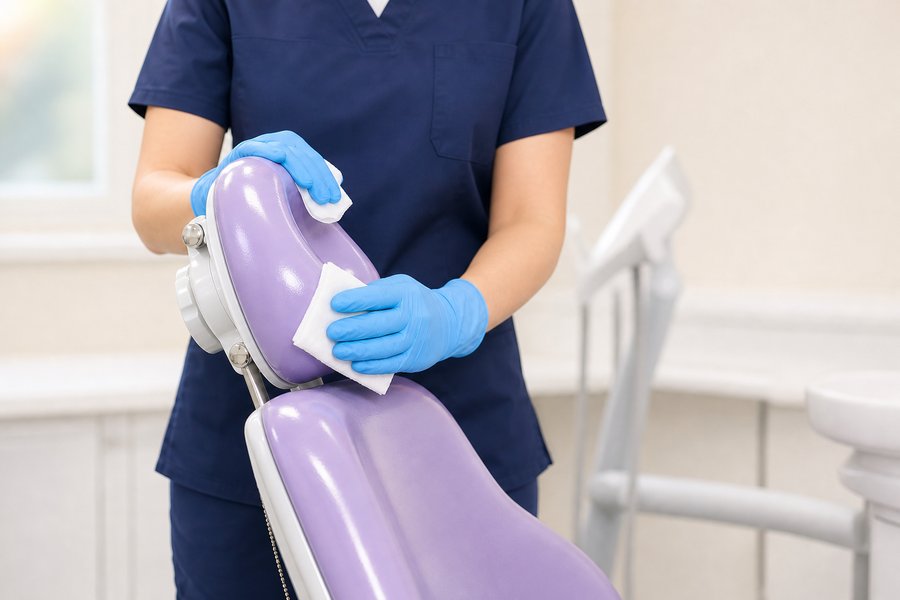
Short answer: the dental chair touches intact skin only, so it is a non-critical item. It is cleaned with detergent between every patient. It does not need routine disinfection. Clear the instruments, waste and barriers first. Take reprocessable items out of the treatment room. Perform hand hygiene and put on new gloves. Then clean from high to low and from clean to dirty. The order Niche Dental suggests is the assistant’s bench and medicaments, the overhead light, the assistant’s bracket and suction hoses, the practitioner’s bracket and couplings, the stools and belly bar, the chair, then the spittoon last.
“The chair needs to be cleaned, not killed. Anything that goes into the patient’s mouth is managed differently.”
Kylie Robb, Founder of Niche Dental
How to clean the dental chair causes more angst in teams than almost any other task. The sequence is one of my most frequently asked questions. How many wipes to use is a close second. No guideline sets out a step-by-step order for a dental chair.
What does this article assume?
- The dental chair is in the contaminated zone, so it is cleaned between every patient.
- The chair is a non-critical item. That sets the pathway: cleaning.
- The chair is managed under standard precautions.
- Every barrier placed in the contaminated zone has been removed, even if it was not touched.
- Other controls, such as dental dam and high-volume evacuation, have already reduced how much contamination reached the chair.
- The method for cleaning is not attempting to sterilise or disinfect the chair.
- The practitioner has already dealt with the sharps.
What does non-critical mean?
This term comes from the Spaulding classification framework (critical, semi-critical and non-critical). AS/NZS 5369:2023 defines a non-critical medical device as one that comes into contact with intact skin but not mucous membranes. Non-critical items present the lowest risk of transmitting infection.
For most non-critical items, like dental chairs and patient eyewear, cleaning after use is the appropriate pathway. Anything that goes into the mouth is semi-critical or critical. Those items are either discarded after use or cleaned and subject to further reprocessing. The chair is not semi-critical or critical. The chair needs to be cleaned, not killed.
What does cleaning mean?
Cleaning, or decontaminating, is the removal of visible contaminants, including residues and biological material, so the item is visibly clean and ready for its intended use. As the dental chair is non-critical, cleaning it between patients is the appropriate pathway.
What happens before the first wipe?
Everything single use or reprocessable comes off the chair, including handpieces, suction tips and any disposable barriers. Waste goes in the treatment room bin. Reprocessable instruments go to the reprocessing area in a lidded container. Gloves off, then hand hygiene.
Put on new gloves to handle the cleaning product and to clean the chair.
How many wipes are needed?
It depends on how wet the wipes are and how big the surface to be cleaned is. At least two are usually needed. Some assistants like a wipe in each hand when cleaning. Work in one direction, from clean to dirty. Change to a fresh wipe once it is dry or visibly soiled.
What is the order for cleaning the chair?
Here is the order Niche Dental suggests:
- Assistant’s bench and medicaments. Wipe the bench and the outside of any bond or medicament bottles brought into the contaminated zone during the appointment.
- Overhead light. The highest surface, including the handles, light cover and switch.
- Assistant’s bracket, triplex and suction hoses. Wipe the hoses from the unit end towards the tip end. Clean the suction holder on the bracket.
- Practitioner’s bracket and couplings. The handpieces have already gone off for reprocessing. Wipe the bracket, then the hoses up to the couplings.
- Stools and belly bar. Both stools, including the height levers, and the assistant’s belly bar.
- Chair. Headrest, backrest, armrests, the chair controls, then the footrest.
- Spittoon. Last. The next patient does not want to see anything in that trap.
How you clean your chair and/or your workflow may differ. That is OK.
If you touch X-ray arms, buttons or equipment during the procedure, these surfaces become part of the contaminated zone and need to be managed between every patient.


In-person course
Infection Control in Sydney
Fri 20 Nov 2026, 9.00 am to 4.30 pm
Canterbury League Club, Belmore
Time for a reset on first principles so your team can think critically and get on with it. Leave with practical resources you can use in the practice on Monday.
$330 a seat. Teams of three or more pay $300 a seat.

Presented by Kylie Robb
Would you not clean the practitioner’s bracket before the suction?
No. The suction does draw body fluid out of the mouth. Two things still put it ahead of the practitioner’s bracket and the chair.
The practitioner is doing the dentistry, so their gloved hands have the most direct body fluid exposure. The assistant still needs gloves for body fluid exposure, but in most instances, their exposure (compared to the practitioner) is less direct. That is my rationale for wiping the suction before the practitioner’s bracket.
The chair is wiped last (before the spittoon, if applicable) because of the footrest. The footrest has just had someone’s shoes on it. Shoes can carry hardy bacterial spores from wherever they have been. You do not want to clean something that has just been on the floor and then wipe surfaces touched by hands that go into mouths.
If this order has triggered concerns or questions for you, you are welcome. The purpose of this article is to get you to think critically about why you do things and what is the purpose of your actions. You are now encouraged to come up with your own policies for how you do things based on your risks and workflows.
What products can be used on the chair?
Chair manufacturers are prescriptive about what can be used on their upholstery and for good reason. I have seen a lot of dental chairs damaged by constant disinfectant use. It is very sad as this damage is not usually covered under warranties. Find your dental chair’s instructions for use (IFU) to determine what products to use.
What now?
Print this article and take it to your next team meeting. Once you have agreed on your order, write it down in your infection prevention and control manual, with the products you use.
If you would like your manual written or reviewed, see manuals and reviews. For the documents your manual should be written from, read the 2026 list.
Sources
- Australian Commission on Safety and Quality in Health Care and National Health and Medical Research Council, Australian Guidelines for the Prevention and Control of Infection in Healthcare (live online)
- Standards Australia, AS/NZS 5369:2023 Reprocessing of reusable medical devices and other devices in health and non-health related facilities, incorporating Amendment 1
- Australian Commission on Safety and Quality in Health Care, Principles of environmental cleaning product selection, fact sheet (2023)
- Australian Commission on Safety and Quality in Health Care, Environmental cleaning practices for small health service organisations (2023)
- Australian Dental Association, Guidelines for Infection Prevention and Control, Fifth Edition Amended (2026)
- Williams GJ, Denyer SP, Hosein IK, Hill DW, Maillard JY. Limitations of the efficacy of surface disinfection in the healthcare setting. Infection Control and Hospital Epidemiology. 2009;30(6):570 to 573.
- Rashid T, VonVille HM, Hasan I, Garey KW. Mechanisms for floor surfaces or environmental ground contamination to cause human infection: a systematic review. Epidemiology and Infection. 2017;145(2):347 to 357.
For more information contact Niche Dental: hello@niche.dental
Last updated 12 October 2026.